

A Simple Breakdown of Seiko’s Origin, Reputation, and How It Compares to Swiss Watch Brands
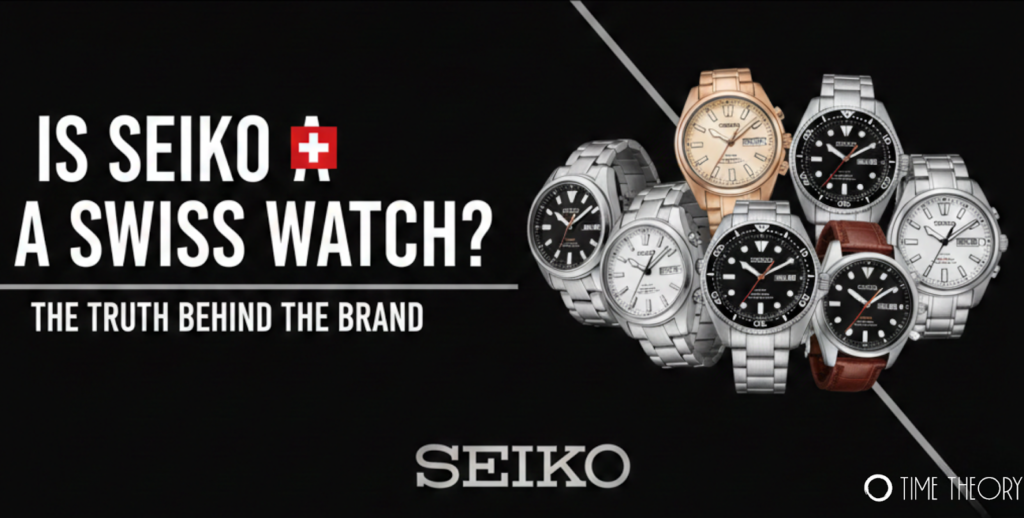
If you’re just starting your journey into the world of horology (that’s a fancy word for the study of time and watches), you’ve likely heard two big names thrown around constantly: “Swiss Made” and “Seiko.”
It’s a common point of confusion. Swiss watches are often seen as the gold standard of luxury and precision. Then you have Seiko, a giant in the industry that seems to match—and sometimes beat—those Swiss standards. It’s easy to wonder if Seiko is actually part of that Swiss heritage.
So, to answer the burning question right off the bat: No, Seiko is not a Swiss watch brand.
But the full story is so much more interesting than a simple “no.” Seiko is actually the pride of Japanese watchmaking, and its history is filled with rivalry, innovation, and a drive that changed the entire watch industry forever. Let’s dig into where Seiko comes from, why it matters, and how it stacks up against the Swiss giants.
The Origin Story: Where is Seiko From?
Seiko is 100% Japanese. The company was founded by Kintaro Hattori in 1881 in the Ginza district of Tokyo. Hattori started by opening a shop selling and repairing watches and clocks. Eleven years later, in 1892, he established the “Seikosha” factory.
The name “Seiko” itself is derived from “Seikosha,” which roughly translates to “House of Exquisite Workmanship.”
While the Swiss were busy perfecting mechanical movements in the mountains of Europe, Hattori was building a fully integrated manufacturer in Japan. His vision wasn’t just to assemble parts bought from others; he wanted to make every single component in-house. This philosophy of vertical integration—where Seiko makes everything from the gears to the oil used to lubricate them—is still a core part of their identity today.
Why Seiko is the King of Japanese Watches
You can’t talk about Japanese watches without talking about Seiko. They are the quintessential Japanese brand. Here is why they are so strongly identified with Japan rather than Switzerland:
Cultural Philosophy
Japanese craftsmanship, or monozukuri, emphasizes precision, continuous improvement, and dedication. Seiko embodies this. While Swiss marketing often focuses on heritage, romance, and tradition, Seiko focuses on technology, efficiency, and absolute precision.
In-House Manufacturing
As mentioned earlier, Seiko is one of the few “fully integrated” manufactures in the world. Many Swiss brands (even expensive ones) buy movements or parts from third-party suppliers. Seiko makes their own quartz crystals, their own springs, their own cases, and their own hands. This level of control is rare and very “Japanese” in its approach to quality assurance.
Swiss Standards vs. Seiko: What’s the Difference?
If Seiko isn’t Swiss, how is it different? The distinction usually comes down to certification and aesthetics.
“Swiss Made” is a legal label. For a watch to carry this label, a certain percentage of the manufacturing costs must occur in Switzerland, and the final inspection must happen there. It’s a badge of honor that usually comes with a higher price tag.
Seiko, on the other hand, adheres to Japanese industrial standards (JIS). These standards are incredibly rigorous, often rivaling or exceeding Swiss ISO standards.
- Design Language: Swiss watches often lean towards classic, ornate, or jewelry-like designs. Seiko watches, particularly their diver models, often prioritize strict functionality, legibility, and durability.
- Movement Philosophy: Swiss movements are famous for their decoration and traditional mechanical complexity. Seiko movements are often built to be workhorses—reliable, easier to service, and incredibly tough.
The Technology That Shook the Swiss
Seiko didn’t just copy the Swiss; they almost put them out of business. This is where the famous “Quartz Crisis” comes in.
The Quartz Revolution
In 1969, Seiko released the Astron, the world’s first commercial quartz wristwatch. It was accurate to within seconds per year, whereas mechanical Swiss watches drifted by seconds per day. It was also cheaper to mass-produce eventually. This technology devastated the traditional Swiss industry in the 70s and 80s, proving that Japanese innovation was a force to be reckoned with.
Spring Drive
Seiko didn’t stop at quartz. They invented the Spring Drive technology (found mostly in their high-end Grand Seiko line). It combines the soul of a mechanical watch (no battery) with the precision of an electronic regulator. The second hand on a Spring Drive watch doesn’t tick; it glides in a perfectly smooth, silent motion. No Swiss brand has replicated this technology.
Build Quality, Craftsmanship, and Reliability
There is a misconception that because Seiko is not Swiss, it must be “cheap.” This couldn’t be further from the truth.
At the entry-level, Seiko offers incredible value. A $250 (Rs 22,489.62) Seiko 5 Sports model will run for decades with minimal maintenance. It’s built like a tank.
As you move up the ladder to the Prospex and Presage lines, the finishing improves significantly. You get better polishing, sapphire crystals, and more intricate dials.
Then, at the very top, you have Grand Seiko (which is now a separate brand under the Seiko umbrella). Watch enthusiasts widely agree that Grand Seiko finishing—especially the polishing of the hands and indices (known as Zaratsu polishing)—is often superior to Swiss luxury brands like Rolex or Omega that cost twice as much.
Price Ranges: Something for Everyone
One of the best things about Seiko is the accessibility. They have a watch for every budget.
- Entry Level ($100 – $350)(Rs 8,995.85 – Rs 31,485.48): This is where the Seiko 5 Sports line lives. Perfect for students or first-time buyers.
- Mid-Range ($400 – $1,200)(Rs35,983.40 – Rs 1,07,950.20): Here you find the Prospex (professional divers) and Presage (dress watches). This is the sweet spot for many collectors.
- High-End ($1,500 – $5,000+)(Rs1,34,937.75 – Rs4,49,792.50): The higher-end Prospex LX line and King Seiko models compete directly with luxury Swiss brands.
- Grand Seiko ($5,000 – $100,000+)(Rs4,49,792.50 – Rs8,995.85): While technically a separate brand now, this represents the pinnacle of Japanese watchmaking, competing with the likes of Patek Philippe and Rolex.
Does Seiko Compete with Swiss Watches?
Absolutely.
If you have $500 (Rs 44,979.25) to spend, a Seiko Prospex diver is likely going to offer better specs and reliability than a Swiss counterpart at the same price point (like a Tissot or Hamilton).
If you have $6,000 (Rs 5,39,751.00) spend, a Grand Seiko “Snowflake” is frequently compared against the Rolex Datejust or Omega Aqua Terra. Many enthusiasts choose the Japanese option because you get a more unique movement and better hand-finishing for the money.
Seiko has earned its seat at the table. They aren’t the “cheaper alternative” anymore; they are a legitimate rival.
A Quick Look at Popular Models
If you are interested in buying a Seiko, here are three names you need to know:
- Seiko 5 Sports: The legendary entry-level automatic. It’s fun, comes in many colors, and is very affordable.
- Prospex: Short for “Professional Specifications.” These are serious dive watches. The “Turtle” and “Samurai” models are icons in this range.
- Presage: This is their dress watch line. They often feature beautiful textured dials inspired by Japanese cocktail culture or traditional craftsmanship like enamel and porcelain.
The Verdict: Is Seiko Worth Your Money?
So, is Seiko a Swiss watch? No. It is proudly Japanese.
But is it worth buying? Without a doubt. Whether you are spending $200 or $10,000,(Rs17,991.70 or Rs8,99,585.00) Seiko offers immense value. They have a history of innovation that changed the world, and they build watches that are meant to be worn and enjoyed for a lifetime.
Don’t let the lack of a “Swiss Made” label scare you off. In the world of watches, “Made in Japan” carries just as much weight for those who know what they are looking for.
Related: Is Casio a Luxury Brand?
Frequently Asked Questions
Is Seiko a Swiss company?
No, Seiko is a Japanese company founded in Tokyo in 1881 by Kintaro Hattori.
Are Seiko watches good quality?
Yes, they are renowned for durability and reliability, offering excellent quality relative to their price point.
Does Seiko use Swiss movements?
No, Seiko is a fully integrated manufacturer and produces all its movements in-house in Japan.
Are Seiko watches expensive?
They range widely, from affordable options around $100–$300 to luxury models costing $5,000 and up.
Is Seiko worth buying?
Absolutely; they are widely considered one of the best value-for-money brands in the entire watch industry.